Ritual as a way to order fear
The Glass Bead GameRitual as a way to order fear describes how a community can give overwhelming dread a form it can bear together. In the rainmaker’s village, Joseph Knecht cannot persuade the people that a shower of falling stars is not the end of the world. He instead leads them in familiar prayers, rhythmic movement, and shared penitence, transforming panic into an ordered act of worship. The episode presents ritual not as proof that the danger has been removed, but as a means of containing fear, restoring communal bonds, and making a crisis inhabitable. A related principle shapes the Glass Bead Game, where meditation and public ceremony turn intellectual display into disciplined, collective attention.
Fear, Piety, and Social Order
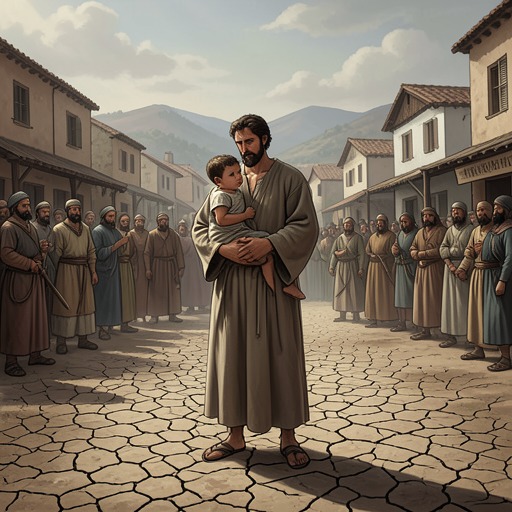
In the account of the village’s way of life, fear is not an obstacle that people can simply overcome. Nature, death, and the spirits remain forces before which people cannot presume superiority. Fear can, however, be pacified, outwitted, masked, and placed within the orderly framework of communal life. Sacrifice and its accompanying rites belong to this work: by transforming some part of fear into awe, people make it a form of piety and thereby give their lives intensity as well as structure. The Rainmaker has a particular responsibility for the sacrifices and ceremonies connected with such fears.
This religious understanding has practical consequences. The Rainmaker’s responsibilities include responding to drought and prolonged bad weather with sacrifices, exorcisms, and processions; in the village’s inherited belief, if persuasion and other methods fail, the Rainmaker himself may ultimately be sacrificed. Such rites belong to a broader division of authority. The Rainmaker determines sowing times by observing the moon and applying experience and inherited rules, while the tribal mother or her oldest female relative performs the first sowing. Ritual therefore orders fear within an established social world, where spiritual responsibilities and communal authority are distinct but connected.
The Falling Stars and the Failure of Reason
The principle becomes a crisis when a host of falling stars appears over the village. Half the people have gathered at the tribal mother’s hut, but fear has already become a public, bodily disturbance: some villagers are rigid with shock, others move uncontrollably, and one woman dances while pulling at her hair. Knecht recognizes that the terror may spread into collective madness. The tribal mother, meanwhile, believes that the end of all things has come. Knecht tries to show her that the familiar stars remain in the sky, but she cannot see or accept the distinction he is making. She agrees with him only when he asks her not to abandon the terrified people.
Knecht initially hopes that explanation, observation, and encouragement will help the villagers share his understanding of the spectacle. He quickly sees that too few will listen in time. Reason cannot reach most of the crowd before fear overwhelms it. The scene establishes an important limit: an accurate explanation may be available, but it is not necessarily an effective response when terror has already become collective. Knecht therefore turns from persuading people to think differently to giving their fear a form they can enact together.
Rhythm as a Communal Remedy
Knecht steps before the crowd and begins the familiar prayers used at public ceremonies of mourning and penance, including rites associated with danger such as epidemics and floods. He calls the words aloud in rhythm, claps his hands, and repeatedly bends and straightens his body. Others join him; the tribal mother murmurs in time and makes small ritual bows. Villagers arriving from their huts take up the beat, while those who have become overwhelmed either collapse exhausted or are drawn into the chorus and its gestures.
The change is not that the falling stars stop or that everyone is persuaded of Knecht’s explanation. Rather, the disorganized crowd becomes a reverent populace prepared for penitence and sacrifice. Each person’s terror is no longer isolated in private panic or released as an uncontrolled cry; it has a place in the rhythm of the ceremony. The rite’s social force lies in its uniformity: rhythm and music confirm a sense of community, while ordered movement gathers separate reactions into a shared response. As the stars continue to cross the sky for another two hours, the villagers move from horror toward submission, prayer, and penitential feeling. By the time the spectacle begins to subside, they feel that their worship has placated the powers and restored order in the heavens. The story presents that feeling as the community’s experience of the event, while distinguishing it from Knecht’s more lasting reflection on what the spectacle means.
Ritual in the Glass Bead Game
The account of the Glass Bead Game offers a different institutional setting for a related discipline of attention. In the Game’s earlier development, players could dazzle others by rapidly summoning large numbers of ideas from memory. Because such virtuosity risked reducing play to display, contemplation became an increasingly important component. After each symbol presented by the director, players were required to meditate silently on its content, origin, and meaning. The practice was meant to keep the Game’s signs from becoming empty marks: players had to attend to what a symbol meant, rather than merely demonstrate how quickly they could produce associations.
The Game also developed from a private exercise into a public ceremonial. Private play remained possible, but the public Games came to be led by senior Masters under the national Master of the Game, with invited guests listening and a wider audience following. Some Games lasted days or weeks, and participants and guests followed rules that even regulated how long they might sleep, living with concentrated, self-denying attention. The annual solemn Game in Castalia likewise brought together different disciplinary tendencies in symbolic harmony, establishing a truce among their competing ambitions and recalling the unity within their variety. In this setting, ritual orders not immediate terror but the pressures of rivalry and fragmentation, giving collective attention a public form.
Meaning and Limits
The falling-star rite is effective because it changes what the villagers can do together, not because it supplies Knecht with a complete explanation of the event. The people remember the disaster afterward as something they faced and withstood, and their recollection gradually loses its initial fearfulness. Knecht does not share that easy release. The spectacle remains an unforgettable warning and a problem he continues to interpret; the passage of time deepens rather than diminishes its importance to him. The difference between the village’s settled story of having survived and Knecht’s continuing inquiry marks the limit of ritual: communal order can contain terror without resolving every question that gave rise to it.
Across the village rites and the Glass Bead Game, ritual works through form, repetition, and participation. In one, familiar prayers and coordinated gestures keep fear from dissolving the community into panic. In the other, silence, meditation, and ceremonial rules restrain empty virtuosity and bind different fields of thought into a shared practice. Neither setting makes order identical to certainty. Instead, each shows how patterned attention can give people a common way to meet what they cannot fully control or comprehend.